

Your brand already shows up in AI answers. The question is whether AI is reliably repeating what you’ve deliberately published, or filling gaps with guesses pulled from across the web: review sites, competitor content, and your old web pages.
Often the most important AI visibility problems aren’t technical. They’re decisions leadership and marketing need to make.
Pricing, best customers and culture
Do we control the narrative or let AI guess?
When we build a website, brochure, or event space, there is some messaging we always include: who we are, what we offer, and the features and benefits of the product or service. But there are some topics that are really interesting to prospective customers and future employees that we don’t always include in marketing copy.
Take pricing. The thinking is, let prospects become interested in what we have to offer, reach out to sales, and sales can negotiate the best price for them. Then we’ll have a truly interested prospect we can continue to reach out to, and our competitors won’t be privy to the details of our pricing.
But what happens when prospects ask AI pricing questions? We asked Claude how much it would cost to hire a Tony Robbins as a speaker.
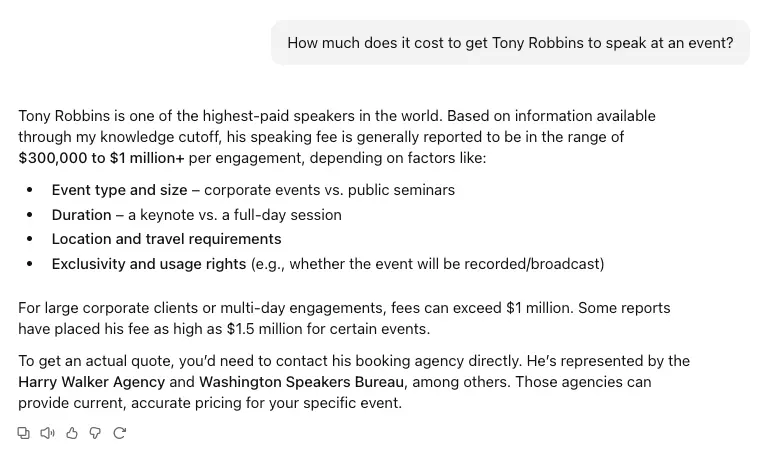
The prices quoted range from $300,000 to $1,500,000 for some events. That’s quite a range. And really not helpful to potential buyers, nor to the speaker himself. That’s a gap wide enough to either scare off the right buyers, or set the wrong expectations with the wrong ones.
How does AI infer answers to questions it can’t find facts to answer? It does the best it can, finding hints of pricing in places like review sites, competitor websites, and your own data hiding out there on the web from time gone by.
Beyond pricing, think about what else people interested in your brand might be asking.
- Future employees might ask for insight into culture, average employee tenure, and work experience in various departments.
- Prospective customers might ask about your customer list to evaluate your credibility and confirm they’re a good fit for you, or competitive comparisons—which we’ll talk about next.
Silence isn’t neutral. Business leadership needs to decide: which truth about our business do we want to stand as fact in AI answers? The one we provide, or the one AI constructs?
Competitors
Do we own the comparison, or let AI make it for us?
A prospect has narrowed their options down to a few solutions. They want to compare them before deciding. In the past, they’d build a spreadsheet. Now, they just ask AI.
B2B buyers evaluate an average of 5.1 vendors before a purchase, up 13% over last year. (Source: 6Sense)
If you haven’t published a comparison on your website, you’re letting AI do it for you. The problem with that? You know your best-fit customer and the unique value you bring far better than any AI model does. Does your content reflect that?
There’s another wrinkle: your competitors may have already published comparison content on their site—directly comparing their solution to yours. AI is using that information to answer your prospects’ questions. You’re not just competing against silence. You’re competing against someone else’s narrative.
This doesn’t mean you need to compare yourself to every competitor. It means you should be intentional about which comparisons matter most to your ideal customers, which situations your solution genuinely serves best, and which problems you solve better than alternatives. Tell that story yourself, and give AI more to work with.
This decision can’t be made by marketing alone. It requires alignment across sales, marketing, revenue, and leadership. Everyone needs to agree on how—and whether—you’re positioning yourself against the competition.
Beyond owned content
How much do we invest in telling that story beyond our own website?
AI doesn’t just read your website. It draws from your entire public footprint: press mentions, backlinks, YouTube, social media, industry coverage, and more. Your brand narrative is built from all of it.
Many marketing teams treat external visibility as a nice-to-have. Or it gets handed off to PR, separate from the core content strategy.
Recent research shows that AI citations for B2B websites correlate strongly with brand ubiquity—how visible you are across multiple channels and sources, not just how authoritative you are on your own site.
How does AI source information for your brand? On average, 43% of citations about a brand are from outside their website. (Source: Profound)
This creates a problem. If your PR team is chasing only tier-one media outlets, you’re missing online publications and channels that matter to AI. If your SEO team is focused on your website, they’re not coordinating with the people who can actually secure external mentions. No single team has a view broad enough to drive this strategically.
The question isn’t whether external visibility matters. It always has. The question is: who owns it now that AI has made it even more important? And how do you coordinate across PR, marketing, content, and leadership to prioritize the right external mentions?
The Cost of Inaction
You could skip these decisions, but they get made anyway: AI guesses at your pricing, positioning, and market presence. That’s a passive path that doesn’t necessarily reflect well on your brand.
The alternative: treat AI visibility as a strategic choice. Decide what matters most, publish the truth about your pricing, your ideal customer, and your offering’s advantages, and build presence across channels that count, deliberately, with data and alignment across the organization.
Do that, and AI visibility becomes an advantage you own, not a risk you manage. And your brand shows up in AI answers not as a guess, but as the story you chose to tell.
Ready to make those calls with confidence? Talk to us about building an AI visibility strategy backed by real data about how your prospects research. Read our AI visibility results from a real client, and then → let’s start a conversation