


A curated roundup of marketing analytics news, tools and ideas — with a focus on the Google analytics stack and the intersection of AI and analytics.
The analytics team speaks regular expressions and the CRM team speaks Klingon
In web analytics, a user is a mythical creature that disappears when you look at it directly. In CRM analytics, anything that isn’t tied to a real human being is considered noise. I’ve been spending a lot of time in the messy space between these two worlds recently, and have been struck by how challenging it is to get people from one world to understand the other. The technical part is hard, but the distance between people’s goals and perspectives can feel insurmountable.
A venn diagram of CRM and web analytics
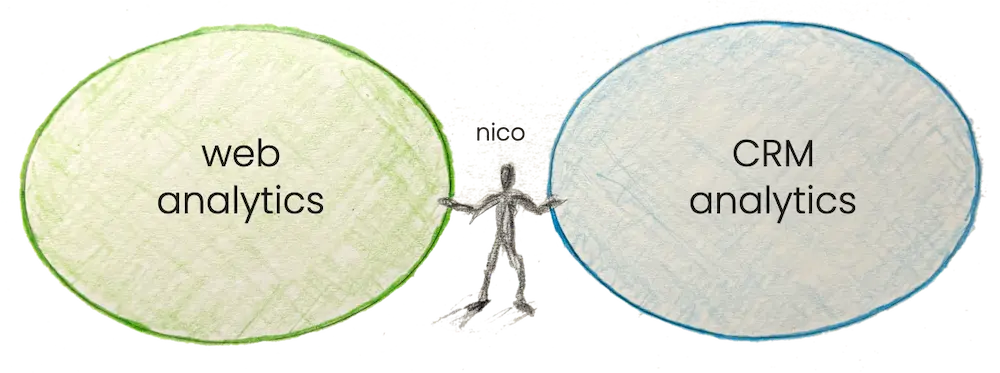
I wouldn’t have drawn that diagram a month ago. I was stuck on the idea that there was a conceptual model that would unify these two worlds, and I just wasn’t smart enough to grasp it. A recent piece by Olga Berezovsky helped me get unstuck. She looks at it as a cost/benefit problem, and lays out heuristics for when to invest in unification, and when to just get on with it and make the best of what you have.
I am also sharing a number of articles about Claude dashboards this month. I’ve tested them out, and from an information-design perspective, they are definitely an improvement over what Claude previously produced. They can be shared externally and updated dynamically as new data comes in. That’s all great, but personally, I don’t see them as a replacement for the role dashboards typically play in analytics communication. Instead, I look at them as a better and more consistent way to present ad-hoc analysis done in Claude. Read on for various opinions from some analytics thought leaders.
Till next time, tlhIngan tIq ghajta’ pat rIk stI weRt. ghaHvaD MaHeghvIpbe’! Qapla’!
Product Updates
- Optimized Tagging Experience For Google Tag Manager, Simo Ahava
After months of buildup, Google has finally rolled out a major change to the Google Tag and GTM. Functionally, the main benefit is that only one Google Tag needs to load to enable Tag Manager, Google Analytics and Google Ads tracking. On the downside, there is a little bit of work involved in switching over to the “optimized” experience, and some aspects of it are pretty confusing. As always, Simo covers it with more depth and clarity than Google’s own documentation. Required reading, IMO, if you work in Tag Manager. - If you prefer video to reading, check out this video from Julius Fedorovicius: Major Google Tag Manager update – Optimized Tagging Experience He also goes through some common questions and gotchas in this follow-up video, including a useful workaround if you use a lookup table variable to set your measurement ID.
AI-assisted analysis
- Claude Dashboards: The Jupyter Notebooks of Agent Age, Simon Späti
This analyst finds Claude dashboards useful for exploration, but not as actual dashboards – they prefer solutions like nao, Evidence, and Rill. Each of those produce dashboards that are built on editable code and all that implies (IDE creation & maintenance, automated testing, source control, etc.). Their main criticisms of Claude dashboards are:- Because the presentation is essentially free-form HTML generated by Claude, governance and maintenance are hard to scale.
- Data has to be loaded into Claude’s environment, and dashboards can only be shared via Claude.
- The Problem w/ Claude Dashboards, Madison Mae
Similar arguments about governability with a bit more emphasis on data security.
In response to both articles, I would say: yes, and maybe dashboards never were all that. I recently worked with a data team that budgeted $350k to build a three-page dashboard with a couple of data sources. It would, of course, have been very curated and governed, and these people knew their shit. That may be an extreme case, but it highlights the friction between the insights business stakeholders need to do their jobs, and the constraints of a formalized process for turning raw data into charts and graphs. So I agree with the points in both articles and I also believe that we, as analysts, need to be a lot more nimble if we want to keep a seat at the table. - An analytics tool has been added to Claude Dashboards upcoming hand-off tools, Mehdi Oudjida
Mehdi’s POV really resonates, “the goal of Conversational Analytics was never to create dashboards, but to answer those very questions precisely, reducing cognitive load and addressing a concern directly.”
This reminds me of a client I once had who would hand write a note, then scan it and send it as an email attachment. Maybe we shouldn’t be putting so much of our attention on more efficiently doing things the old way, but rather look ahead towards what this new technology makes possible. - 5 Ways AI Agents Will Transform Data Management & Analytics, Akshay Chame & Ritwika Chowdhury, Modern Data 101
One of the transformations the author cites is an interesting counterpoint to several of the articles above, “the dashboard is an artifact of a world where humans were the last mile of analysis. AI agents eliminate that bottleneck.”
To some extent, it doesn’t matter what you or I think. This article lays out an exciting vision for the future that will capture the imagination of the C-suite. That’s what tends to drive planning decisions. - Data Agent Kit is now GA: Bring Google Data Cloud to any coding agent, Google
The Data Agent Kit is a free set of MCP tools and agent skills that connects coding agents (e.g. Claude Code, Codex, or Antigravity) directly to Google Cloud data services such as BigQuery, Bigtable, and Apache Spark/Iceberg lakehouses. I use VS Code + Claude Code + GCP regularly, and my first impressions are really positive. It’s a bit like having a GCP expert that is intimately familiar with your environment hiding in your laptop. Not in a creepy way. Ok, maybe a tiny bit creepy. - Can data agents do real analysis?, Dan Poppy / Shreya Shankar
Spoiler: not really. There are some familiar arguments about humans’ ability to synthesize and our remarkable aptitude for interpreting complex visual data. What I found most interesting was Shankar’s evidence-based argument for how much knowledge, effort, and vigilance is required to ensure that agents stay on track.
Data visualization & reporting
- Tufte’s Razor: How much data is there in your chart?
A fun, interactive tutorial on Edward R. Tufte’s data-ink ratio concept. The gist is that ink equates to information load, so when you put ink on a page, make sure it is working on behalf of the information you want to convey. But that sounds kind of boring. The tutorial is anything but.
Attribution & measurement
- Agentic Commerce May Break Your Measurement Before It Breaks Your Strategy, Corey Abramson, Seer Interactive
I found this article a little hard to follow, but it’s a really important topic if you sell things online, and not many people are talking about it. Should you allow agents to purchase your products without a human ever visiting your website? How do you gauge the impact of agentic commerce when so much of it is not directly measurable? The author is working through this with his own clients and shares his perspective. - Court Filing Quotes OpenAI Engineer: Users “Won’t Click” Links, Matt G. Southern, Search Engine Journal
It’s no secret that referred traffic from AI platforms is minimal compared to how often a website gets cited, but court filings in a lawsuit include some real data. One example is that “CTR was 87% to 93% lower in Bing Chat than in Bing Web Search for The (New York) Times’s websites.” The data is several years old and specific to a few publishers, but ChatGPT and Claude are so tight-lipped about user behavior patterns that anything is better than nothing. - How to Remove Bot Traffic from GA4 With a GPU Check, Dana DiTomaso
A narrative journey through bot detection that ends with an interesting discovery about GPUs. The article includes free sample code and very-specific instructions for setting it up. - How to Set Up Cloudflare to Block Unwanted Bot Traffic From Your Website and Analytics, yours truly
After lots of whackamole with bot detection in GTM, I’ve mostly ended up letting Cloudflare do the work for me. For even better results, combine this with the method that Dana shared.
Ideas
- Story of Attention, Amrut Joshi
A lovely little story that analogizes the fundamental workings of a transformer (the LLM type versus shape-shifting robots) without all of the advanced math and academic lingo. If you are starting from a place of zero comprehension, this won’t help you understand how LLMs work. But if you have some grasp of tokens, embeddings and whatnot, it might help the pieces fall into place.

- Chain of Thought For Humans, Adam Newgas
A two-minute read about the benefits of speaking your thought process out loud, even if it makes you “sound like a bit of a loon.”
I’ve long been compelled by the story of Amos Tversky and Daniel Kahneman, who developed some of their most impactful ideas by walking and talking. Maybe I can get some of the same benefits by making myself a Kahneman puppet to talk to…
Privacy
- How to test consent banners by location with the CMP geolocation URL builder, Phil Pearce, MeasureMinds
A handy, free tool for checking consent banner behavior from different regions.
Miscellaneous
- Monte-Carlo simulations, Eli Bendersky
Monte Carlo simulations are ubiquitous in forecasting/prediction modeling, and useful to have in your analytics toolbelt. This article provides several clear examples of when and how to use them, and why they are so powerful.
If you’d like help using your marketing data to generate better insights and faster, more consistent reporting, check out our marketing analytics services and reach out.