
A curated update on marketing analytics news, tools and ideas — with a focus on the Google analytics stack and the intersection of AI and analytics.
The Art of Throwing Things Away
Like a lot of people, I find myself fretting about the demand for my skillset as AI models get better and better. Being well-practised in battling self-doubt, I have a contrary voice ready to chime in, “the core abilities of an analyst aren’t GA troubleshooting or lambda functions, they are critical thinking and the ability to see the forest and the trees.” Sometimes my better self wins the argument, sometimes it doesn’t, but on a rational level I believe that an analyst is a necessary archetype within an organization. And by “organization” I mean a group of people, not robots.
I also recently realized that there is something I need to learn how to do a lot better: throw things away.
I think this is true for most people in my profession. At this moment in history, it may be the most critical skill we collectively lack.
Several recent product releases drove this point home for me (more follows on each further down):
- ChatGPT’s new data agent makes me wonder if I should be rethinking most of the AI-assisted processes we have implemented in my analytics team in the last year. And could my emotional attachment to Claude be a problem? Uh oh.
- I’ve spent quite a few hours in the last year developing a toolset for better, faster deliverables for our clients. I’m working up the courage to shitcan a big chunk of it in favor of dbt Charts.
- And after devoting a fair amount of time to understanding what large language models can and can’t do, I feel like I need to start back at square one with decision models (the next big thing in AI, according to some).
Throwing things away doesn’t come easily to me, especially things in which I have invested time. In the past few years I’ve done a pretty good job of letting go of some of the tools, skills and methods that got me to where I am, but I kind of thought the new tools, skills and methods I was acquiring would be in place for a while. The breakneck pace of AI development and the cacophony of products, repos, frameworks, etc. in its wake have put the kibosh on that hope.
The art of it is knowing when to throw something away. In my personal life, I am a loyal friend and partner, and I have shirts that are older than my grown children. That isn’t changing (ok, maybe I’ll change my shirt). But when it comes to software tools and methods, in 2026, loyalty is no longer serving me. As uncomfortable as it is, I have to be open to the idea that a new solution may be the best solution to every problem I face.
Worth knowing about: MeasureSummit is happening on October 6-7. A number of people I greatly admire and regularly cite in this newsletter will be presenting, and it’s free to watch the livestream and only a few hundred dollars to get full access to recordings. Compared to other conferences of this caliber, that’s a great deal.
Product Updates
- New updates to measurement suite in Google Ads, Google
This article is a mix of new features, gradually-evolving features and a somewhat muddled philosophy of measurement. It includes:- “Directly integrating Data Manager into Google Analytics,” which streamlines importing data into GA, including other ad platforms and first-party conversion data.
- Additional support for enhanced conversions in GA.
- General availability for Meridian GeoX, Google’s free incrementality testing framework. For a deep dive into GeoX, check out this video from Kishaloy Mukhopadhyay.
- Google Analytics now allows you to add a hostname include filter. E.g., you can configure your GA property to only track events from specified domains. At first blush, this seems like a no-brainer. I often encounter unwanted domains when I audit a client’s GA property, which this would prevent. But here’s my concern: filters prevent traffic from ever reaching GA, which means you don’t know what you don’t know. Many capabilities, such as form handlers, booking systems and shopping carts live on other domains. In an ideal world, any and all changes web developers make are frequently and thoroughly communicated to the analytics folks, and filters, etc. are updated, but we don’t live in that world. I think I’ll stick with the exclude filter for now.
- Data Studio now supports bulk styling of metrics, chart lines and bars and other visual elements. This will be a big timesaver. It comes on the heels of a bunch of other recent charting improvements—it’s nice to see feature momentum picking up, even if the features aren’t very sexy.
- The “unification” of Google Tags and Google Tag Manager seems to be quietly chugging forward. This was first announced at Google Marketing Live, and there have been a few more ‘coming soon’ mentions since. I continue to be most excited about visual tagging—I’m sure there are commercial benefits (for Google) for the unification part, but as a user it seems like Google Tags will continue to be confusing, just in a different way.
- Google Tag Manager recently added automated version naming. A peeve of mine is going into a container and finding a whole lot of nothing in the version history, so a big thank you to the GTM team. If you are using an MCP for documenting and auditing Tag Manager setups, this should also help a lot with context.
AI-assisted analysis
- Now everyone can put data to work, OpenAI
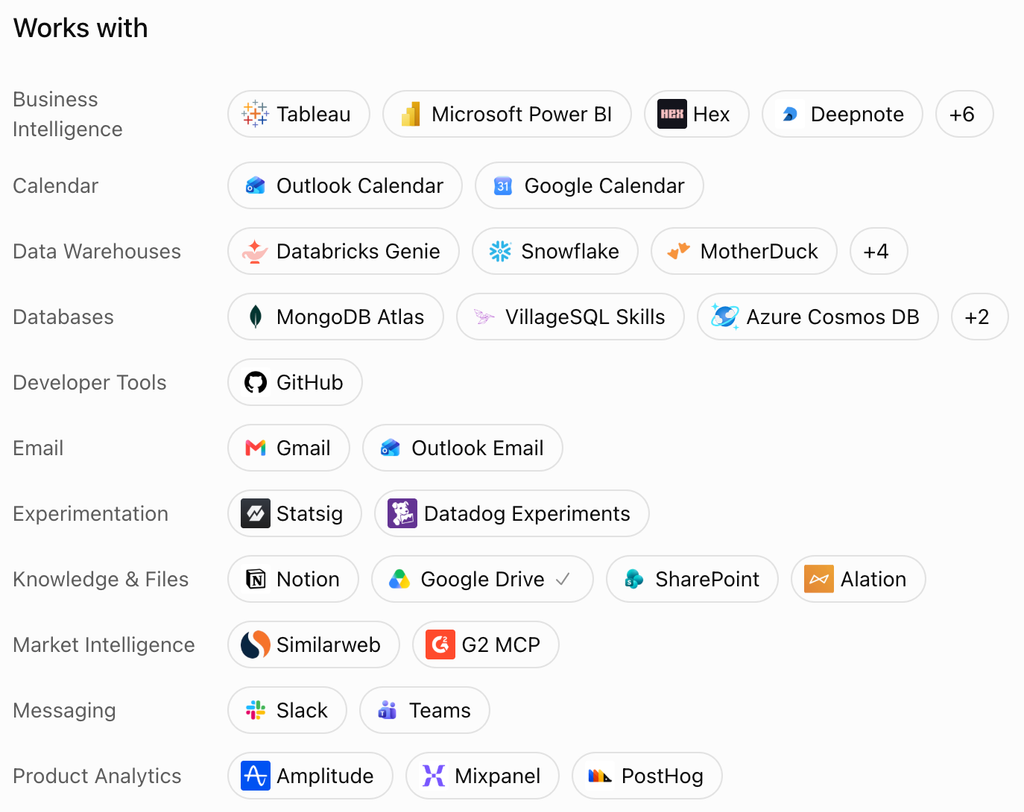
Well, not everyone. This is ChatGPT’s new data agent, with skills for analysis, context-building, dashboarding and a variety of other analyst tasks. We use BigQuery as our data warehouse, which is not supported on my subscription level, so I haven’t played around with it yet. It does connect to BigQuery at a higher subscription level, plus a lot of other common tools. Below is a screenshot of what it supports now, and I’m sure this list will be growing fast.
- Context, Semantics, and Ontology: A Primer for the Agentic Era, Simon Spati, MotherDuck
A not-too-opinionated explanation of where context and semantic layers fit in the AI stack. The least amount of space is given to ontologies, which seems ok unless you work in a knowledge domain on the outskirts of common understanding.
Data visualization & reporting
- Dashboards in Google Analytics (New Feature), Julius Fedorovicius
Last month, I was pretty dismissive about Google Analytics’ new dashboarding capabilities. Julius does a detailed walkthrough and points out several features that make me like them more. One is that you can add element-level filters, i.e. you can filter a scorecard to show a specific event; another is that you can add a dashboard to the UI, alongside existing tabs. Right now I mostly ignore the default Overview tabs, because the signal-to-noise ratio is pretty low. They are customizable, but this seems like it might be a better option. - Charts built for Chat, dbt
dbt hired RJ Andrews to help design an open-source “structured YAML language that can declare a full interactive dashboard in one auditable YAML file.” Andrews is a data-visualization luminary, and it shows in the results. I’ve tested it with MCP data sources in chat, and am starting to incorporate it into more structured workflows—the charts and dashboards it produces are both attractive and easy-to-understand. And because it’s an open standard, it encourages transparency and consistency.
Attribution & measurement
- Don’t make the mistake of buying attribution too soon, Barbara Galiza
A case for why you should prioritize testing over attribution modeling. The latter is a lot more appealing for those of us who like building things, but pointless without a good foundation and the juice may not be worth the squeeze. - How to use multiple MMMs to make better paid media decisions, Ben Vigneron, Search Engine Land
Vigneron makes a case for building MMMs on Robyn, Meridian, and PyMC all at once. Since nearly all of the work is in data prep, and all are good, free options, there’s no real downside. He describes why the results will vary and what you can learn from the differences. I also really like the recommendation to run a geo test at the end to inform discrepancies and generate priors for the next run.
But before you get too worked up about MMM, read this.
Ideas
- We Must Pace the Frontier, Dario Amodei
Amodei, the CEO of Anthropic, is calling for regulated controls over AI development. I personally think it’s bat-shit crazy that anyone disagrees. You need to comply with codes and get an inspection to put a deck on your house—does anyone seriously believe that the risk of falling four feet off a deck is greater than the risk from AI? Google, OpenAI, and Anthropic are all taking steps to make AI safer. Maybe not fast enough, and maybe not exactly to our liking, but we need to think in terms of lesser evils here. As consumers, we hold a lot of power. Pay attention to who is trying to do it right, and vote with your dollars when you buy tokens. - AI Doesn’t Need to Talk to Be Great. Meet Decision Models., Ignacio de Gregorio
For decades before LLMs “sucked all the air from the room”, AI researchers were working on methods for making different types of decisions. This article describes the work of Jev, an AI company focused on building a generalized model that can make any type of decision, and do it better and a lot cheaper than LLMs.
Privacy
- From Traces to Tools: A New Way to See What Your Website Is Really Doing, Stéphane Hamel
The philosophy and methods behind a new tool for understanding exactly what is and isn’t happening when tags fire on a website. Good for discovering privacy issues, but it also looks like it will be very helpful for data hygiene. The tool isn’t out yet.
Miscellaneous
- Building Data Platforms That Outlive Their Stacks: Rent the Technology, Own the Code, Sameer Joshi, Modern Data 101
A strong business case for why business logic, data transformation, and modeling should live in a place where you can easily migrate it from one system to the next. The idea is not original, but the way he expresses it is a joy, “Rebuilding a working codebase every five years because you married a vendor is not an investment, but rather a tax you volunteered to pay.” - The Data Adoption Business Case Calculator, Charlotte Ledoux
Very helpful if you find yourself having to explain or argue for a budget for data governance. I like that it avoids any claims of increased profitability or marketing ROI. I certainly believe that well-governed data contributes to both, but the business case always involves a bit of squinting and guesswork. This comes down to saving data consumers’ time, and her reasoning is pretty iron-clad. - 5 Methods for Assessing Causality in Statistics, Jim Frost
The next time an LLM makes an assertion from data you give it, ask it to give you a confidence level on the assertion. Then ask it to explain how it derived the confidence level. After you get past your WTF?! feelings, you will probably want to read and understand this article, or hire someone who does.