
A curated roundup of marketing analytics news, tools and ideas — with a focus on the Google analytics stack and the intersection of AI and analytics.
There’s a tension in marketing analytics that forms a throughline this month: AI tools are getting better and more integrated into our analytics workflows, even as our job is getting harder because the actions we are trying to measure are shifting from humans to AI agents. Below I share some of the AI tools and practices that have given me superpowers, as well as some of the AI supervillains I am battling.
The Pope even makes a guest appearance. Who would have thought?
Product updates
There were A LOT of analytics-related announcements at Google Marketing Live last month. Here are a few highlights:
- Qualified Future Conversions, Attributed Brand Searches, and Lead Intent Scores – a little short on details, but these are three new Google Ads metrics that use inference & AI to tie together funnel stages.
- The scope of Data Manager is expanding into Google Analytics. It is currently mostly a tool for importing audiences and conversion data into Google Ads – it is becoming a centralized place for managing data flows. Google Analytics has been adding a lot of capabilities for importing cost and performance data from other platforms, but the implementation is scattered, making setup confusing and governance hard. For example, here is the process for importing Facebook data – not particularly complicated, but weirdly hidden for such a powerful feature. The expansion of Data Manager should be a big improvement!
- The architecture of Tag Manager and the Google Tag are changing significantly. Functionally, the biggest changes will be a point-and-click interface for setting up triggers, and streamlined setup for sending events to multiple Google products. There are also a number of behind-the-scenes changes, most notably a consolidation into a single script for all Google Tags. Simo Ahava provides a bit more detail than Google’s brief announcement.
- Google Analytics added a new AI Assistant channel group, and an automatic ‘ai-assistant’ Medium assignment to AI traffic sources. I’ve been adding this as a custom channel group to client setups for a while, but it’s nice to know that Google will be handling the maintenance from now on.
- Meta Ads released an MCP for ad management and reporting. I mostly focus on analysis and prefer the Jepto MCP mentioned below, but this looks to be pretty useful if you want to automate management tasks.
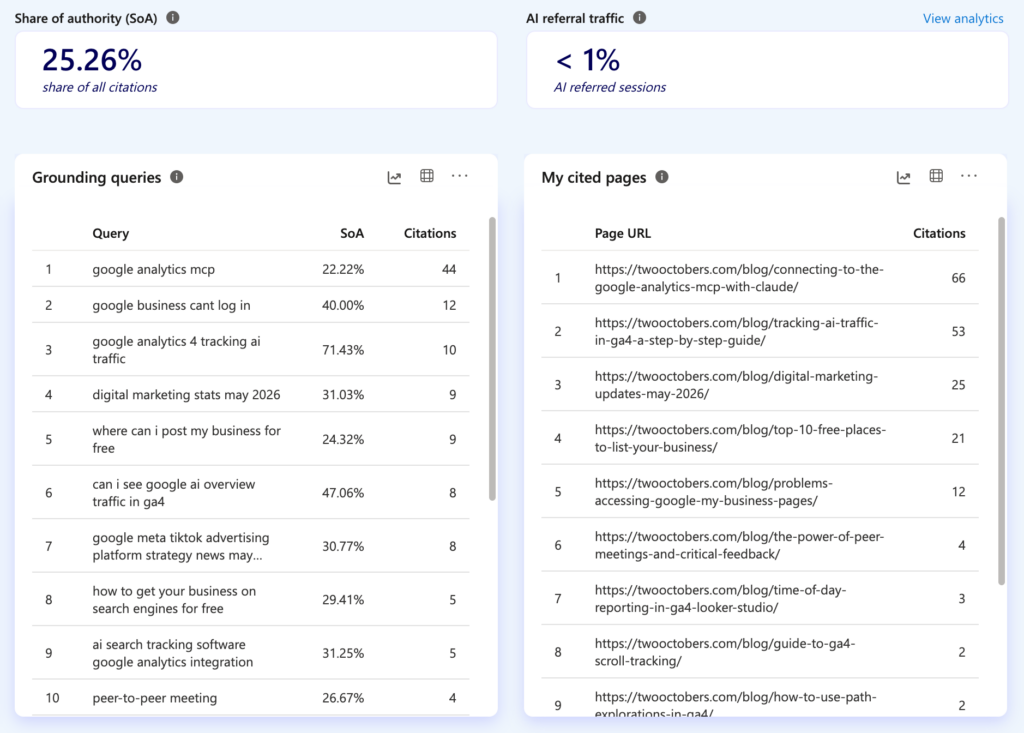
- Microsoft Clarity added Citations to their AI Visibility reporting. It’s based on Copilot data, which probably isn’t your top priority, but it’s real, user-based data versus the guessing we have to do on other LLMs. IMO it’s a great data source for prompt research.
AI-assisted analysis
- Use live artifacts in Claude Cowork, Claude Help Center
Claude Artifacts “allow you to turn ideas into shareable apps, tools, or content”, but up until now had the major limitation that you had to publish a new artifact every time you wanted to make a change. This is a big leap forward, but as of this writing only works locally on your computer with Claude Desktop. - Five things I believe about the future of analytics, Tristan Handy
Prognosticating from the CEO of dbt. He didn’t say this exactly, but my takeaway is that AI is making the analyst less dependent on the technology organization – data engineers, analytics engineers, etc. Not an original take, but there are a lot of details and nuance in his POV that are worth reading. - Human in the Loop – The Responsible Choice?, Peter Baumann
An argument for why the current trope of human-in-the-loop AI governance isn’t governance at all. It stings a little because I kind of agree with him and am guilty of the simplification he describes.
Data visualization & reporting
- The 5-layer framework for measuring GEO performance, Paul DeMott, Search Engine Land
A list of good things to include in AI visibility/performance reporting. There is a lot of noise out there on this topic. This article does a good job of explaining the benefits and limitations of various metrics. - How to build custom SEO reports with Claude Code and Google Search Console, Bruce Clay, Search Engine Land
A detailed, how-to walkthrough with a genuinely useful outcome.
Attribution & measurement
- Tracking AI User Bots in Cloudflare to Measure AI Visibility, yours truly
Instructions and a GitHub repo that show you how to report on AI user bot traffic with Cloudflare. Tracking and reporting on AI user bots can be a good proxy for AI visibility, and is included in the Paul DeMott AI-reporting framework above. - LLM trackers are quietly breaking their users’ own analytics, Jan-Willem Bobbink
A bit of a wet blanket on the approach I describe in the previous post: the act of monitoring prompts with Profound, SEMrush, etc. can materially impact bot traffic statistics. But as us marketing data analysts like to say, “at least it’s directionally accurate?” - When AI Agents Become Users: Rethinking Analytics Tracking, Olga Berezovsky
As websites and applications add AI-assisted interfaces that allow users to get things done without clicking and navigating, our tracking setups are becoming obsolete. The author describes a framework for tracking the world ahead. - Store Speed and Conversion: What the Data Shows, Mateusz Krzeszowiak, Shopify
Fascinating stats on the relationship between website performance and ecommerce purchases. I generally take vendor-published data with a grain of salt, but still, wow.
Ideas
- AI + work
Since reading Steve Yegge’s The AI Vampire several months ago, I’ve been fretting and reading a lot about the impact of AI on work. Here are a few recent standouts:- Batter Up: AI, Labor, and the Policy Gap Nobody Is Closing, John Hughes
Implications of AI job displacement on public safety nets, with lots of relevant data. - The dignity of work at a time of digital transition, Pope Leo XIV
Teaser, “while AI promises to boost productivity by taking over mundane tasks, it frequently forces workers to adapt to the speed and demands of machines, rather than machines being designed to support those who work.” I’m not a Catholic, but much about the Pope’s recent encyclical gives me hope. I’m excited about AI, but I also believe we need leadership that has the heart and commitment to understand all of the implications and address the risks. I’ll take that leadership wherever we can get it. - Returning to life!, Hadley Wickham
One data nerd’s struggle to reconcile the positive and negative impacts of AI. Very much mirrors some of what I’m feeling.
- Batter Up: AI, Labor, and the Policy Gap Nobody Is Closing, John Hughes
- If AI Can Replace Workers, Why Is It Hiring Consultants?, Ben Rogojan (Seattledataguy)
The title of this article threw me off, it sounds like a counterpoint to some of the doomsday scenarios above, but it is really a thesis about how AI companies are creating partner infrastructures because humans are needed to shepherd the transition to a future we can’t possibly imagine. - The end of the IT-tyranny, Helge Tennø
In a nutshell: most software is bad. AI coding is making it easier for people to build their own. Mo software, mo better. That’s a glib summarization – I always find Tennø’s writing insightful. - When the Picture Is the Data., Stevo Ledbetter
A wonky article about interacting with data by drawing on a visualization. Benefits of this approach include:- We can process complex information visually a lot faster and better than we can by cognitively interpreting columns and rows.
- GPUs are more efficient at processing data than CPUs.
The article uses 2D, lat/lon data as an example, which is a pretty obvious use case, but it gets me fantasizing about VR exploration of 4D data (3 dimensions + time).
Miscellaneous
- How BigQuery Actually Executes a Query (and why most optimization advice misses half the picture), Lasha Dolenjashvili
An enlightening examination of how BigQuery works.