
New cross-channel analysis features in GA
Google Analytics recently added new reports for Cross-channel budgeting, cross-channel conversion reporting, assisted conversions, and funnel analysis. I have mixed feelings.
These are features I desperately wanted several years ago, but I have since soured on the promise of multi-touch attribution (MTA). Privacy controls, zero-click searches, and the walled gardens of social media platforms are just some of the factors that make it impossible to reliably measure a user’s journey to conversion.
It also doesn’t help that I tested out these new reports in a client GA property that had a catastrophic quantity of fraudulent PMax conversions. If you are not familiar, Google Ads Performance Max campaigns have a tendency to generate spurious conversions, due to shady Google AdSense partners that manipulate performance data to generate more ad revenue on their sites.
As a result, the new attribution reports show “Cross-network” as the dominant channel:
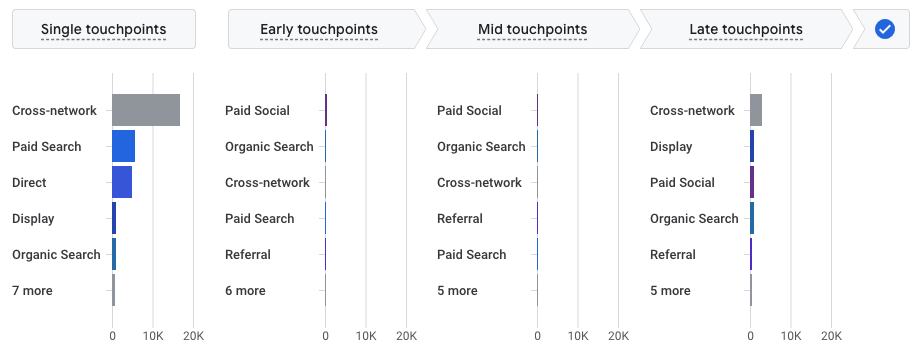
If only it were true. Unfortunately, we need to add data accuracy to the list of problems with MTA.
That said, I’ve been wanting GA to give me more visibility into cross-channel behavior since forever, and I am a firm believer in the adage that ‘perfect is the enemy of good’. I will be analyzing these new reports for insights, and reviewing them with clients, warts and all.
I will also continue to promote incrementality testing and MMM for more holistic analysis. For example, check out an excellent article by Benjamin Wenner, mentioned below 🙂
Product Updates
- Looker Studio:
- Cross data source filtering – one dropdown filter can be configured to work on multiple data sources – for example, you can create a global query filter that applies to Search Console and Google Ads.
- Histogram charts – histograms are a staple of statistics and data science. They are essential for visualizing how data is distributed. For analysts, they are helpful for discovering patterns that a simple average will never show. For example, average order value (AOV) is a popular ecommerce metric, but can hide the fact that revenue clusters around single item purchases and subscriptions.
- Google Tag Manager: Google tag gateway is now available on Akamai. Tag gateway proxies Google tags on your own domain, helping to avoid some script blockers and network security features. It has been available for a while on Cloudflare, and I’ve seen a 5-10%-ish improvement in conversion attribution when it is implemented. That’s more anecdote than science, so results may vary. Google also says it’s in beta on GCP, but I haven’t seen that in the wild yet.
- Google Ads/Google Search: Google has just announced the Universal Commerce Protocol, which will allow shoppers to research and buy products without ever leaving Google. This is what people in the analytics community are saying about it:

Workflow
- Stape GTM Helper – Chrome Web Store
This is a simple Chrome extension that adds some organization to GTM previews in Tag Assistant. If you’ve ever had to troubleshoot a container with dozens of tags, you need this. - New Research: AIs are highly inconsistent when recommending brands or products, Rand Fishkin
This article starts by sowing a lot of fear and doubt, but gets around to: “All of this reinforces the notion that visibility percent, across loads of prompts, whether written by humans or generated synthetically, are likely to be decent proxies for how brands actually show up in real AI answers.” The useful takeaway for me is that the volatility of visibility measurement goes down significantly if you monitor a large list of prompts. Not earth-shattering, but it’s helpful to have data to back up what you probably would have recommended anyway. - AEO: Answer Engine Analytics | Best Reports, KPIs, Metrics, Avinash Kaushik
After reading the previous article, I was skeptical about this article’s focus on Average Position as a KPI, but apart from that it outlines an excellent, data-driven process for AEO. It also includes the best use of a radar chart that I’ve seen in years. - The RFV Playbook, Patrick Hegnauer
“RFV” stands for “Reach. Flow. Value.”, which the author presents as a pragmatic framework for planning and prioritizing tracking initiatives. If you’re sitting there thinking, “like I need a new framework,” I can relate. But I do really like this one – it is simple, actionable, and aligns analytics work with business value.
Attribution
- In 2026, the web flips to agent-first design, Tomasz Tunguz
“(M)any websites become agent-first rather than people-first… Consequently, the front door needs to be designed for robots, while the side door caters to people.” This is prediction number 11 of the author’s predictions for 2026. He is not just any prognosticator, as his credentials will attest. My instinct is that his timeline is aggressive, but given the Universal Commerce Protocol announcement above, probably not by much. The implications for web analytics are huge, whatever the timeline. Right now, most organizations are paying zero attention to LLM bot behavior, and if they were they would realize how difficult it is to extract meaning. I expect to be spending a lot of time on this in the year ahead. - Not all MMM tools are equal: Meridian, Robyn, Orbit, and Prophet explained, Benjamin Wenner
Media/Marketing Mix Modeling (MMM) uses statistical methods to infer relationships between marketing channels and conversions, versus trying to measure user behavior with cookies. This article compares several of the top open-source models. If you decide now is the time to start getting up to speed on MMM, I also recommend checking out PyMC. They have great learning resources and a solid model of their own. Or, if you learn best through comedy, there’s this.
Warning: there’s a lot of math in MMM – open-source models make the machinery of MMM widely accessible, but IMO you still need someone qualified to drive the machine. - Using AI to generate insights and actionable next steps from MMM data, Barbara Galiza and Aditya Puttaparthi Tirumala
If the previous resources get you jazzed about MMM, this very wonky article gets into details about how to use AI to improve MMM workflows and outcomes.
Ideas
- Serve the Haters, by Sven Balnojan PhD
(this website appears to be down at the moment, so apologies if the link doesn’t work)
The author equates the current state of the business intelligence/data engineering tools industry to Blockbuster, and the AI-assisted ease of embedding data intelligence close to the end user as Netflix. And at the risk of pointing out the obvious, Netflix ate Blockbuster’s lunch. A problem with the analogy, in my opinion, is that Netflix made content consumption more efficient and more expansive, whereas the author’s vision expects us to put our blind trust in Meta Ads, Hubspot, etc. That doesn’t mean he’s wrong, just that it kinda sucks if he’s right. - The Analytical Skills No One Teaches You, Olga Berezovsky (guest posting on Seattledataguy)
Critical thinking skills from one of the best.
Miscellaneous
- Google Analytics 4 tutorial for beginners, Julius Federovicius
I doubt anyone who’s made it this far is a beginner, but Julius is the O.G. of GA4, and you probably know someone who could use a leg up.
- New Edition of Google Analytics Alternatives!, Jason Packer
This is the definitive resource for people who have decided it is time to switch.