
Paid Media
Update by Casey Anderson, Director of Paid Media
The major paid media platforms are racing to win on automated, AI-driven performance — Meta via its creative and bidding stack, Google with Demand Gen and new recommendation transparency. For advertisers, the playbook is: keep diversifying channels, feed the algorithms clean first-party data, and verify that automation is actually moving the needle. Here’s what’s new this month.
Meta Is on Track to Overtake Google in Global Ad Revenue
For the first time, Meta is projected to pass Google in worldwide ad revenue this year. According to eMarketer forecasts published in April 2026, Meta will reach roughly $243.5 billion in net global ad revenue, narrowly edging out Google at $239.5 billion — 26.8% of worldwide digital ad spend versus Google’s 26.4%.
The bigger story is the speed of the shift. Meta’s ad revenue is growing at an estimated 24.1% this year, more than double Google’s projected 11.9%, fueled by Reels, Advantage+, and AI-driven creative tools.
If Meta has been a secondary channel in your media plan, it’s time to pressure-test that. Advertisers leaning entirely on search and shopping risk missing where attention and budgets are accelerating. A mix that pairs intent-driven search with Meta’s reach and AI-optimized targeting will likely outperform a single-platform strategy in 2026.
Google Expands Demand Gen for Faster YouTube Conversions
Google’s April Demand Gen “drop” introduced two updates that meaningfully change how advertisers drive bottom-of-funnel results across YouTube, Shorts, Discover, and Gmail.
Demand Gen now joins Commerce Media Suite. The practical effect: brands can apply their first-party catalog and conversion data to Demand Gen campaigns directly inside Google Ads, reaching higher-intent shoppers across Google’s most visual surfaces. Previously, this was only available through Display & Video 360 and Search Ads 360.
Google also added View-Through Conversion (VTC) optimization to Demand Gen. Campaigns can now bid for users who watched an ad and converted later without clicking — closing a longstanding measurement gap on YouTube and bringing Demand Gen closer to how Meta and TikTok already optimize.
Demand Gen is evolving from a “Discovery campaign” successor into Google’s full visual performance product. If you’ve been running brand-leaning YouTube campaigns and treating conversions as a downstream byproduct, VTC optimization gives you a cleaner, faster signal to bid on.
Google Ads Adds a “Results” Tab to Recommendations
A smaller update worth flagging: Google Ads rolled out a new Results tab inside Recommendations that shows the measured impact of bid and budget changes after they’re applied.
When you apply a budget or target recommendation, Google compares actual performance against an estimated baseline of what would have happened without the change, then surfaces the lift — extra conversions, spend efficiency — as a 7-day rolling average over a 28-day window. It covers Budget and Target recommendations today.
Anyone (like us!) who has been skeptical of Google’s auto-applied suggestions now has a built-in scoreboard. It’s a small step toward accountability for platform-side automation, and it makes it easier to decide which recommendation types are worth accepting. Pair it with your own reporting in Looker Studio or GA4 for the clearest picture.
SEO & AI
Update by Brett Woodward, Sr. SEO
Google Business Profile posts can now be scheduled and set to repeat
GBP posts are getting more useful. Updates, offers, and events can now be scheduled to go live at a future date and time, and events and offers can now be set to repeat at custom cadences.
Now any business can spend a few hours creating months worth of posts, set it and forget it. This is good news for anyone not already using our Postamatic tool that was created by Two Octobers alum Noah Learner for this exact purpose.
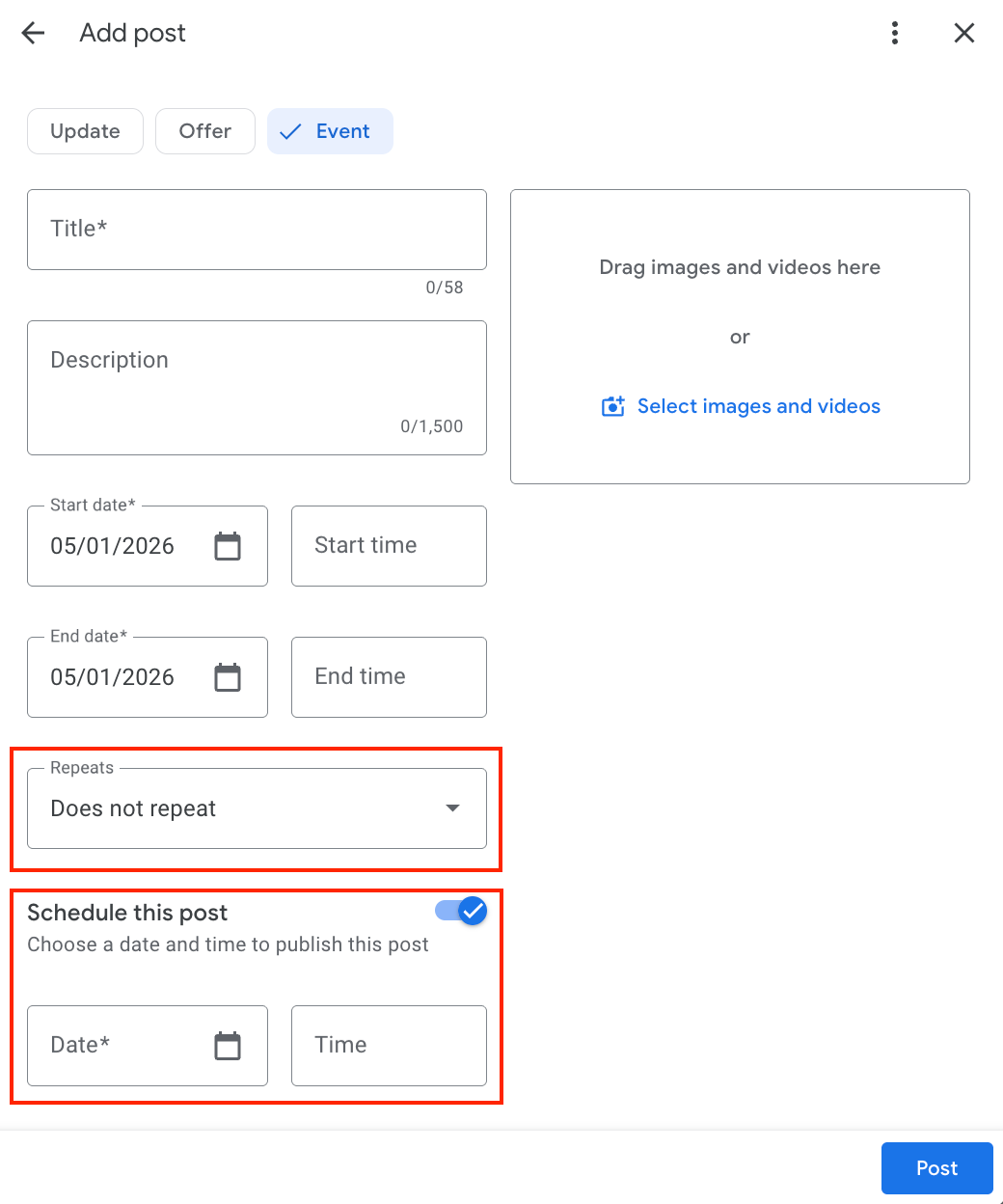
We always tell clients to utilize GBP posts as free advertising space. It’s a great way to get messages out there on the search results pages, show customers your business is active, and motivate them to engage.
At an SEO conference last year I heard Brad Wetherall, a former Director at Google who led the Google Business Profile team, say that your Google Business Profile is your new homepage in this new search landscape. And I think that’s a great idea for local business to keep in mind.
For starters, as Google gets better at keeping users in the search ecosystem, fewer users will click through to independent sites. That means every bit of real estate you can occupy on the results pages is worth leveraging.
Plus, adding information about your business to your GBP via posts (or your services, your bio, etc.) is a great way to feed Google more info that Gemini can then repeat back to searchers.
So if you aren’t taking full advantage of your GBP, here’s your sign. It’s more than just a place to update your hours. It’s actually a critical intersection of what Google knows about your business and what it can share with users.